About
Baltimore Pallets
Baltimore's trusted source for industrial pallet solutions. Built on precision, reliability, and sustainable practices.
Industrial
Excellence
Baltimore Pallets serves the greater Baltimore and Maryland region with comprehensive pallet services. Our facility in Elkridge provides strategic access to major distribution routes and manufacturing centers.
We combine industry expertise with sustainable practices, offering complete pallet lifecycle solutions from purchase to recycling. Every pallet we handle meets rigorous quality standards.
Our team brings decades of combined experience in logistics, warehousing, and material handling. We understand that pallets are critical infrastructure for your operations.
Years Experience
Serving Baltimore's industrial sector with reliable pallet solutions.
Pallets Monthly
Processing volume through our buy, sell, and repair operations.
Active Clients
Businesses trust us for their ongoing pallet requirements.
Our Values
Quality First
Every pallet inspected, graded, and certified. We never compromise on structural integrity or safety.
Rapid Response
Same-day service available. We understand urgent logistics needs and respond accordingly.
Sustainability
Comprehensive recycling programs. Environmental responsibility integrated into every service.
Fair Pricing
Transparent pricing based on market rates, grade, and volume. No hidden fees or surprises.
Partnership
Long-term relationships built on reliability. We grow alongside our clients' operations.
Expertise
Deep industry knowledge. Custom solutions engineered for your specific requirements.
Company History
Founded in 2008 during the financial crisis when businesses needed cost-effective pallet solutions. We grew from a single-bay operation to a 40,000 square foot facility serving the Mid-Atlantic region.
Team Expertise
Our staff includes certified forklift operators, NWPCA-trained graders, and logistics coordinators with 10+ years industry experience. Combined team experience exceeds 150 years in pallet operations.
Facility Capabilities
Our Elkridge facility features 40,000 sq ft covered storage protecting inventory from weather exposure. Drive-through loading bays accommodate simultaneous pickup and delivery operations for maximum efficiency.
Equipment Inventory
Fleet includes five flatbed trucks, eight forklifts with 5,000-8,000 lb capacity, and specialized pallet repair stations. Automated nailing equipment increases repair throughput while maintaining quality standards.
Certifications Held
ISPM-15 certified treatment facility authorized for export pallet production and marking. EPA compliant for wood waste handling and recycling operations under federal environmental regulations.
Safety Record
Zero lost-time accidents in the past 36 months through rigorous safety training and equipment maintenance. Monthly safety audits ensure OSHA compliance and continuous improvement of workplace protocols.
Community Involvement
Annual donation of pallets to Habitat for Humanity Baltimore for construction projects. We sponsor local youth sports teams and participate in Howard County Chamber of Commerce initiatives.
Growth Trajectory
Processing volume increased 200% over past five years driven by e-commerce boom and sustainable business practices. Continuous investment in equipment and facility expansion positions us for continued regional leadership.
Our Operational Excellence
Advanced Facility Infrastructure and Equipment
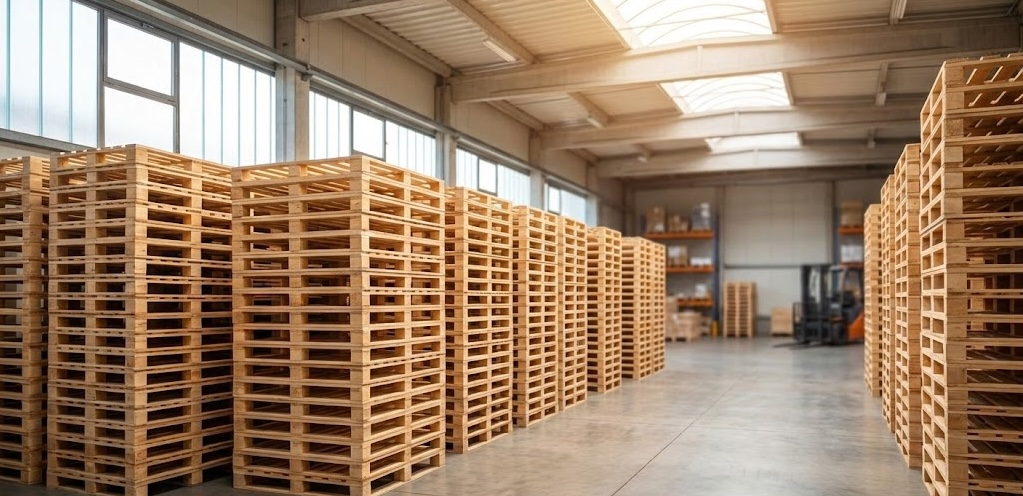
Our 40,000 square foot facility in Elkridge represents a significant investment in infrastructure designed specifically for pallet operations. The covered facility protects our inventory from weather-related degradation that can compromise wood integrity, reduce load ratings, and introduce mold or decay issues. Unlike outdoor storage yards common in the industry, our covered approach ensures consistent quality regardless of seasonal conditions. The building features eight loading bays with dock levelers accommodating trucks from 16-foot box trucks to 53-foot tractor-trailers, enabling simultaneous loading and unloading operations that maximize throughput during peak demand periods.
Our equipment fleet represents continuous investment in operational capacity and safety. We maintain eight forklifts ranging from 5,000 to 8,000-pound capacity, including specialized models with extended forks for handling double-stacked pallets and narrow-aisle capabilities for dense storage configurations. Five flatbed delivery trucks enable responsive logistics across our service area, with GPS tracking systems providing real-time visibility to customer deliveries. Our repair operations utilize pneumatic nailing stations capable of driving 70 nails per minute, alongside automated board removal systems that safely extract damaged deck boards without compromising reusable stringers. This mechanization enables our three-person repair crews to process 250-300 pallets per eight-hour shift while maintaining consistent quality standards.
The facility layout reflects decades of operational experience translated into efficient material flow. Incoming pallets enter through our south bays where they undergo initial grading and sorting into A, B, C, or repair categories. Grade-A pallets proceed directly to secure storage in our climate-controlled section designated for premium inventory. B-grade units move to our high-bay storage utilizing selective pallet racking that stores 6,000 pallets in less than 10,000 square feet of floor space. C-grade and damaged pallets flow to our repair area where triage determines repair feasibility. Units beyond economical repair feed into our recycling operation where we recover usable lumber, separate metal fasteners for scrap recycling, and reduce remaining material to wood chips for landscaping applications.
Technology integration has dramatically improved our operational efficiency and customer service capabilities. Our warehouse management system tracks every pallet through barcode scanning, providing real-time inventory visibility across all grade categories and sizes. Customers with standing orders receive automated notifications when inventory falls below reorder thresholds, preventing stockout situations that disrupt operations. Our dispatch system optimizes delivery routes considering traffic patterns, delivery time windows, and truck capacity to minimize fuel costs and maximize on-time performance. The system has reduced our cost-per-delivery by 23% since implementation while improving average delivery times by 35 minutes across our service area.
Quality Control Systems and Industry Standards
Quality control in pallet operations extends far beyond simple visual inspection, encompassing structural testing, dimensional verification, and compliance documentation that protects both our reputation and our customers' operations. Our grading process follows National Wooden Pallet and Container Association (NWPCA) standards, the industry benchmark for consistent pallet evaluation. Three members of our team hold NWPCA Certified Pallet Inspector credentials, having completed the organization's comprehensive training program covering pallet design, load testing methodologies, and grading criteria. This certification ensures our grading aligns with industry standards and provides customers confidence that our Grade A truly represents premium quality while our Grade C accurately reflects economy-grade limitations.
Our grading criteria for each category reflect specific structural and cosmetic standards verified through multi-point inspection. Grade A pallets must exhibit zero broken or missing boards, no stringer damage, secure fasteners with no protruding nails, and uniform appearance suitable for customer-facing applications or export shipments. These pallets typically originate from single-trip applications or carefully managed closed-loop systems where they've experienced minimal handling cycles. Grade B pallets, our highest-volume category, may show minor cosmetic wear and accommodate up to two repaired deck boards provided structural integrity remains intact. These units must demonstrate full load capacity with no compromised stringers or loose blocks. Grade C pallets serve cost-sensitive applications where appearance is secondary to functionality, allowing more extensive repairs, cosmetic damage, and weathering provided the pallet can safely complete its intended use cycle.
Load testing protocols verify that our graded pallets meet stated capacity ratings, protecting against catastrophic failures that create workplace hazards and product damage. While we don't load-test every individual pallet-economically infeasible given our volume-we maintain a statistical sampling program testing representative units from each acquired batch. Our testing rig applies controlled loads simulating dynamic forklift conditions, static warehouse storage, and selective rack configurations. A standard 48x40 stringer pallet must support 2,500 pounds dynamic load (forklift transport) and 5,000 pounds static load (floor storage) to meet our Grade B specifications. Grade A pallets regularly exceed these thresholds, often demonstrating 3,000+ pound dynamic capacity. Any batch failing our sampling tests undergoes 100% screening to remove substandard units, ensuring consistent quality reaches customers.
Documentation and traceability have become increasingly important as corporate sustainability reporting requirements and supply chain audits demand verified information about material sourcing and handling. We maintain detailed records of pallet sources, grading results, repair activities, and final destinations for all inventory passing through our facility. For ISPM-15 certified export pallets, we provide treatment certificates documenting heat treatment compliance, facility certification numbers, and treatment dates. Large customers conducting supplier audits regularly request our quality control documentation, certification records, and safety protocols. Our comprehensive record-keeping has proven valuable in resolving customer disputes, supporting insurance claims, and demonstrating compliance during regulatory inspections. We've successfully passed 14 customer audits in the past three years, with several customers citing our documentation standards as exceeding industry norms.
Strategic Location and Market Position
Our Elkridge location provides strategic advantages serving the Baltimore-Washington corridor, one of the nation's most concentrated logistics regions. Within a 30-mile radius, we access Port of Baltimore (10th largest US port by cargo volume), BWI Airport's cargo operations, and three major interstate highways (I-95, I-695, I-70) connecting to national distribution networks. This positioning enables us to serve import-heavy operations requiring pallet disposal services, export-focused manufacturers needing ISPM-15 certified materials, and distribution centers moving goods along East Coast networks. Our proximity to Port of Baltimore proves particularly valuable-we've developed relationships with shipping terminals, freight forwarders, and customs brokers that generate consistent demand for export-grade pallets while providing access to imported pallets requiring domestic redistribution.
The Mid-Atlantic market dynamics favor our business model combining pallet sales, purchasing, repair, and recycling services. Unlike single-function competitors focusing exclusively on new pallet manufacturing or used pallet brokerage, our integrated approach captures value across the entire pallet lifecycle. We purchase damaged pallets from warehouses seeking disposal solutions, repair economically viable units to B-grade specifications, and sell them to cost-conscious operations. Pallets beyond repair enter our recycling stream where we recover lumber for future repairs and process remaining material into mulch products. This circular model generates multiple revenue streams from the same material inputs while providing customers comprehensive solutions through a single vendor relationship rather than managing separate suppliers for procurement, disposal, and recycling needs.
Market positioning emphasizes service quality and reliability rather than competing solely on price, differentiating us from brokers operating on thin margins with inconsistent supply. We maintain significant inventory-typically 10,000-15,000 pallets across all grades-ensuring availability even during supply crunches that periodically affect the pallet industry. During the 2021 lumber shortage when new pallet prices spiked 60-80% and lead times extended to 8-12 weeks, our inventory buffer enabled us to continue serving customers without interruption. Several competitors unable to source inventory lost key accounts during this period; we gained 23 new customers frustrated by supplier stockouts. This experience reinforced our strategy of carrying higher inventory levels despite the capital investment required, as availability during crisis periods generates customer loyalty that persists through normal market conditions.
Our customer base reflects the region's economic diversity, spanning e-commerce fulfillment centers, manufacturing facilities, food distribution operations, and export-oriented businesses. Top customers include three fulfillment centers collectively processing 5,000+ pallets monthly, two food distributors requiring clean, food-grade pallets for grocery deliveries, and four manufacturing exporters dependent on our ISPM-15 certified inventory for international shipments. We've deliberately avoided over-concentration in any single customer or industry segment-our top five customers represent just 32% of revenue, providing stability if individual accounts face business challenges. This diversification proved valuable during the 2020 pandemic when some sectors experienced severe disruptions while others accelerated; our blended portfolio maintained relatively stable volumes even as individual customer needs fluctuated dramatically.
Team Culture and Industry Expertise
Our team of 18 full-time employees brings specialized expertise across pallet operations, logistics coordination, and customer service functions. Five certified forklift operators manage material handling with safety records that exceed industry benchmarks-we've maintained zero lost-time accidents for 36 consecutive months compared to industry averages of 3.2 incidents per 100 full-time workers annually according to Bureau of Labor Statistics data. This safety performance reflects our investment in training, equipment maintenance, and fostering a culture where employees feel empowered to stop operations if they identify hazards. Monthly safety meetings review near-miss incidents, discuss industry best practices, and recognize employees demonstrating exceptional safety awareness. We've found that this proactive approach reduces incidents while improving employee morale and retention in an industry where annual turnover frequently exceeds 40%.
Our operations team includes three NWPCA Certified Pallet Inspectors who establish our quality standards and train other staff in proper grading techniques. These certifications require passing comprehensive examinations covering pallet design principles, load capacity calculations, wood species identification, and grading criteria for various pallet types. The certification process includes hands-on training grading actual pallets under supervision of industry experts, ensuring theoretical knowledge translates into practical application. We subsidize certification costs for employees and provide paid time for study and examination, viewing these investments as enhancing our team's capabilities while demonstrating commitment to professional development. Several competitors have attempted to recruit our certified staff, but our compensation packages, work environment, and growth opportunities have resulted in retention rates exceeding industry norms.
Customer service and logistics coordination require understanding not just pallet specifications but customers' operational contexts, scheduling constraints, and problem-solving during supply chain disruptions. Our inside sales team averages 8 years industry experience, enabling them to recommend optimal pallet grades for specific applications, identify cost-saving opportunities, and troubleshoot issues like dimensional mismatches or capacity requirements. They manage complex logistics including coordinating deliveries around limited dock access windows, arranging specialized equipment for difficult loading situations, and expediting emergency orders when customers face unexpected needs. During a recent situation where a customer's regular supplier failed to deliver before a critical shipment deadline, our team located 300 pallets in our inventory, arranged after-hours loading, and delivered by 6 AM enabling the customer to meet their commitment. These service-level differentiators generate customer loyalty that transcends simple price competition.
We've invested significantly in employee development and creating a positive work environment in an industry that sometimes undervalues labor contributions. Warehouse roles offer starting wages 15-20% above local minimum wage with clearly defined advancement paths to lead operator, quality inspector, and eventually supervisory roles. We provide health insurance, retirement matching, and paid time off-benefits sometimes absent in smaller pallet operations where labor is viewed as a commodity cost to minimize. This approach has yielded measurable benefits: our average employee tenure is 6.3 years compared to industry averages around 2.5 years, reducing recruitment and training costs while building institutional knowledge that improves operations. Long-tenured employees develop relationships with regular customers, understand seasonal demand patterns, and identify process improvements that newcomers would miss. We've promoted eight employees to supervisory or management roles since 2008, demonstrating genuine advancement opportunities rather than empty promises.
Environmental Responsibility and Sustainability Leadership
Sustainability initiatives in the pallet industry face unique challenges balancing economic viability with environmental responsibility. While pallet recycling has long been standard practice driven by economic incentives rather than environmental concerns, we've deliberately enhanced our sustainability practices beyond profit-motivated minimums. Our recycling operation diverts approximately 500 tons of wood waste from landfills annually, processing material through a multi-stage system that maximizes value recovery. Repairable pallets receive new deck boards or stringers extending their service life by 2-3 years. Units beyond economical repair are disassembled with usable boards segregated for future repairs while damaged material feeds our wood chipper. Metal fasteners are separated using magnetic systems and sold to scrap metal recyclers, recovering approximately $8,000 annually in material that would otherwise be lost. The resulting wood chips are sold to landscaping companies, mushroom growers, and biomass fuel operations, generating additional revenue while ensuring virtually zero material reaches landfills.
We've established partnerships with corporate customers pursuing ambitious sustainability targets who view responsible pallet management as contributing to broader environmental goals. Our closed-loop pallet management programs enable customers to meet corporate commitments while reducing costs through extended material lifecycles. We provide detailed sustainability metrics documenting environmental impact including tons of material diverted from landfills, equivalent carbon emissions reductions, and comparisons to single-use pallet alternatives. Several customers feature these programs in annual sustainability reports and corporate social responsibility communications, valuing both actual environmental benefits and the reputational advantages of demonstrated commitment to sustainable practices. We've found that sustainability-focused customers often prove more loyal and less price-sensitive than purely cost-driven accounts, as switching suppliers would disrupt sustainability metrics they've committed to maintaining.
Our facility operations incorporate environmental considerations beyond pallet recycling, including energy-efficient LED lighting throughout the warehouse, efficient route planning that minimizes fuel consumption, and equipment maintenance protocols that optimize fuel efficiency while reducing emissions. We've explored installing solar panels on our facility's 30,000 square foot roof, though current economics suggest a 12-15 year payback period that we're monitoring as technology costs decline and utility rates increase. We maintain EPA Subtitle D compliance for wood waste handling, documenting material flows and disposal methods that satisfy regulatory requirements while exceeding minimum standards. During our most recent EPA inspection, regulators specifically noted our comprehensive record-keeping and material tracking systems as exemplary practices that could serve as models for other facilities in the region.
Looking forward, we're investigating emerging sustainable materials and technologies that could reduce the pallet industry's environmental footprint. Compressed wood fiber pallets manufactured from post-industrial waste represent an intriguing option that eliminates fasteners entirely while achieving comparable strength characteristics. We've tested several brands in our operations and with select customers, gathering performance data on durability, handling characteristics, and total cost of ownership. Current pricing remains 50-70% above traditional wooden pallets, limiting market acceptance, but costs continue declining as manufacturing scales. We're also monitoring developments in bamboo and hemp pallets, both rapidly renewable alternatives to traditional lumber, though current availability and regulatory frameworks remain barriers to commercial adoption. Our willingness to test innovative solutions positions us as a thought leader in the regional pallet industry, generating positive press coverage and reinforcing our brand as forward-thinking rather than simply transactional.
Future Vision and Market Evolution
The pallet industry is experiencing significant evolution driven by e-commerce growth, supply chain digitization, and changing customer expectations around service quality and transparency. E-commerce fulfillment operations have fundamentally different pallet needs than traditional retail distribution, requiring higher volumes, consistent quality for automated handling systems, and flexible delivery schedules accommodating 24/7 operations. We've adapted our business model to serve this growing segment through standing inventory commitments, same-day delivery capabilities, and quality specifications ensuring dimensional consistency required for robotic handling systems. E-commerce currently represents 35% of our revenue compared to virtually zero a decade ago, with growth projections suggesting 50%+ within five years as traditional retail continues shifting toward online channels.
Technology adoption will likely accelerate throughout the supply chain ecosystem, including pallet tracking and management systems providing unprecedented visibility into material flows. RFID tags and GPS trackers enable real-time location monitoring, automated inventory reconciliation, and data-driven insights into pallet utilization patterns. Major retailers including Walmart and Target mandate pallet tracking for suppliers, driving technology adoption throughout supply chains. We're positioning to support customers implementing tracking systems through partnerships with technology providers, offering tagged pallets as a value-added service. The data generated reveals optimization opportunities-our pilot projects show that 15-20% of pallet movements are redundant, representing significant efficiency gains for customers willing to analyze and act on visibility insights. As tracking technology costs decline and customer sophistication increases, we anticipate pallet management evolving from intuition-based toward data-driven approaches.
Geographic expansion represents a potential growth avenue, though we're proceeding cautiously given the capital intensity of establishing new facilities and the localized nature of pallet operations. The pallet industry rewards proximity to customers due to transportation costs representing 25-40% of delivered pallet costs. Expanding 50+ miles from our current location would require establishing satellite facilities or acquiring existing operations in target markets. We've explored opportunities in the Northern Virginia and Philadelphia regions where strong industrial activity and port access mirror our Baltimore market dynamics. However, we're balancing growth ambitions against maintaining service quality and financial conservatism that has enabled us to weather industry cycles including the 2008 recession and 2020 pandemic without borrowing or layoffs. Any geographic expansion will likely involve acquiring established operations with existing customer relationships rather than greenfield startups requiring years to build market presence.
Our long-term vision centers on being the premier full-service pallet provider in the Mid-Atlantic region, distinguished by quality, reliability, and customer service rather than simply the lowest price. This positioning requires continuous investment in facilities, equipment, personnel development, and systems that support operational excellence. We're evaluating warehouse management system upgrades that would integrate with customer ERP systems enabling automated order processing, inventory visibility, and predictive analytics forecasting pallet needs based on historical patterns. We're also exploring value-added services including on-site pallet management programs where we station personnel at customer facilities managing their pallet inventory, coordinating repairs, and ensuring availability. These programs deepen customer relationships while generating recurring revenue streams insulated from commodity-price competition. Success in this vision requires maintaining our organizational culture emphasizing quality and service while scaling operations and adapting to evolving market conditions. After 15+ years in business, we've demonstrated resilience through economic cycles; the next phase involves translating operational excellence into strategic growth.
By the Numbers
Monthly Volume
Pallets processed through our buy, sell, repair, and recycling operations each month across all service categories.
Square Feet
Covered facility space protecting inventory from weather damage and ensuring consistent quality year-round.
Active Clients
Businesses across manufacturing, distribution, retail, and export sectors trust us for ongoing pallet needs.
Years Operating
Since 2008, serving Baltimore's industrial sector through economic cycles with consistent quality and service.
Material Recovery
Nearly all materials recycled through repair, component recovery, or conversion to landscaping products.
Loading Bays
Multiple docks with levelers enable simultaneous loading and unloading for maximum operational throughput.
Months Accident-Free
Zero lost-time accidents through rigorous safety training, equipment maintenance, and proactive hazard identification.
Emergency Service
Round-the-clock availability for urgent pallet needs and emergency supply chain disruptions.
Annual Recycling
Over 500 tons of wood waste diverted from landfills annually through comprehensive recycling programs.
Avg Years Tenure
Employee retention far exceeding industry averages through competitive compensation and advancement opportunities.
Inventory On Hand
Substantial inventory across all grades ensuring availability even during industry supply shortages.
Daily Repair Capacity
Skilled repair crews process 250-300 pallets daily using specialized equipment and industry-standard techniques.
Our Journey
Founded During Financial Crisis
Baltimore Pallets launched as a single-bay operation when the financial crisis created urgent demand for cost-effective pallet solutions. Businesses sought alternatives to expensive new pallets, creating opportunities for quality used pallet suppliers. Our founder recognized this market gap and established relationships with warehouses needing pallet disposal services and manufacturers requiring affordable materials.
Facility Expansion
Growing customer demand necessitated moving from our original 5,000 square foot facility to a 15,000 square foot warehouse in Elkridge. This expansion enabled covered storage protecting inventory quality and included our first dedicated repair operation. We added three full-time employees specializing in pallet grading and repair, establishing quality standards that became our competitive differentiator.
ISPM-15 Certification
Obtained ISPM-15 treatment facility certification enabling us to serve export-focused manufacturers requiring compliant pallets. This certification required significant investment in heat treatment equipment and staff training but opened a high-value market segment. Export pallets command 20-30% premiums while Baltimore's port proximity provided access to consistent demand.
Fleet and Equipment Investment
Purchased five delivery trucks and eight forklifts enabling responsive logistics and eliminating dependence on third-party carriers. This investment improved delivery reliability while reducing per-unit transportation costs. GPS tracking systems provided customer visibility and enabled route optimization that decreased fuel consumption by 18%.
Current Facility Opening
Relocated to our current 40,000 square foot facility featuring eight loading bays, high-bay storage systems, and dedicated repair areas. This expansion tripled our operational capacity and positioned us to serve the emerging e-commerce fulfillment sector requiring higher volumes and consistent quality. The facility investment totaled $2.3 million including building improvements and equipment.
Pandemic Resilience
Navigated the COVID-19 pandemic without layoffs or service disruptions while some competitors ceased operations. E-commerce surge offset declines in traditional retail and manufacturing sectors. Implemented safety protocols protecting employees while maintaining operations as an essential business. Customer loyalty increased as reliable supply became critical during supply chain chaos.
Technology Integration
Implemented warehouse management system providing real-time inventory visibility and automated reorder notifications for customers with standing orders. Upgraded dispatch software optimizing delivery routes and providing customer tracking. These technology investments improved operational efficiency by 28% while enhancing customer service through visibility and communication.
Continued Growth
Processing 50,000+ pallets monthly with 500+ active customers across diverse industries. Exploring geographic expansion while maintaining service quality that differentiates us in competitive markets. Investing in team development, facility enhancements, and technology capabilities supporting our vision as the Mid-Atlantic region's premier full-service pallet provider.
Frequently Asked Questions
Where is Baltimore Pallets headquartered?
Our main facility is in Elkridge, Maryland, giving us quick access to Baltimore, DC, and regional freight corridors.
How long have you been serving the Baltimore market?
Our leadership team brings 15+ years of pallet operations experience, serving manufacturers, distributors, and 3PLs.
What certifications or compliance standards do you follow?
We provide ISPM-15 heat treatment, adhere to NWPCA repair standards, and maintain OSHA-compliant safety practices.
Do you specialize in certain industries?
Yes, we support manufacturing, warehousing, food and beverage, retail, pharma, e-commerce, and government contracts.
How do you ensure pallet quality?
We grade every pallet, use ring-shank fasteners, and run inspections; repaired pallets carry workmanship guarantees.
What is your monthly processing capacity?
We process 50,000+ pallets monthly through purchase, repair, and recycling lines with room to scale for contracts.
Are your services insured and documented?
Yes, we maintain full liability coverage and can supply COIs, treatment certificates, and route documentation on request.
Do you offer sustainable pallet programs?
We prioritize repair-first strategies, run recycling programs, and partner with certified fiber recovery facilities.
What are your operating hours?
Standard hours are Monday–Friday 8am–6pm and Saturday 9am–4pm, with on-call support for urgent logistics needs.
How can new clients start working with you?
Submit your requirements through our contact form or call; we’ll align on grades, volumes, delivery cadence, and pricing.